 Bonevia
Bonevia
Bonevia
Choosing Self Tapping Bone Screws in 2026 requires more than comparing diameter, length, and price. These small implants influence fixation stability, surgical time, and patient recovery. The right choice depends on bone quality, fracture pattern, anatomical location, and the surgeon’s technique. A screw that performs well in dense cortical bone may behave differently in fragile osteoporotic tissue.
Industry data supports careful evaluation. Grand View Research’s recent orthopedic devices market analysis identifies trauma fixation as a major technology segment, driven by aging populations and rising fracture treatment needs. The International Osteoporosis Foundation reports that osteoporosis causes millions of fractures worldwide each year, increasing demand for dependable fixation systems. These figures show market growth, but they do not prove that one screw design is universally superior. That distinction matters.
This guide examines thread geometry, cutting flute design, core diameter, material selection, insertion torque, and pilot-hole requirements. It also considers titanium and stainless-steel performance, imaging compatibility, sterilization documentation, and available clinical evidence. FDA device databases and ISO 13485 quality-system requirements can help buyers assess manufacturer reliability, although regulatory clearance does not replace clinical judgment. Look closely at technical files, testing methods, and instructions for use. Ask practical questions: Does the screw cut smoothly? Does it resist stripping? Can the driver maintain firm engagement through a small incision?
No single specification tells the whole story. Laboratory results may not represent every patient or surgical setting. That limitation deserves attention. By combining published evidence, surgeon experience, and transparent supplier documentation, healthcare teams can make more defensible choices in 2026.
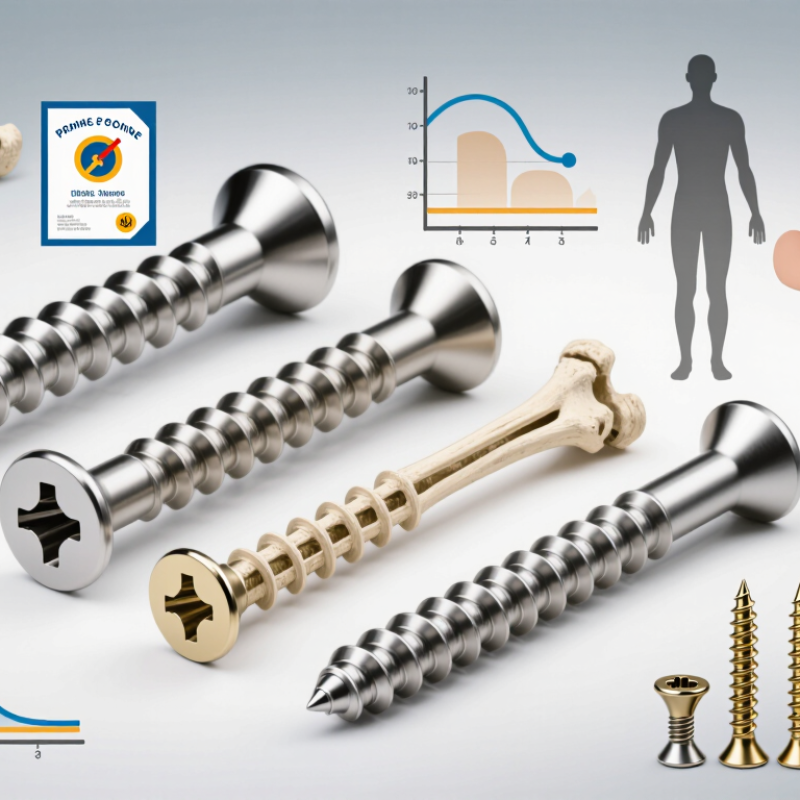
2026 How to Choose Self-Tapping Bone Screws?
ISO 5835 should be treated as a dimensional reference, not a complete clinical classification. It describes metal bone screws with an asymmetric thread and hexagonal drive connection. Key data include nominal diameter, core diameter, pitch, thread length, screw length, head geometry, and drive dimensions. These measurements help define whether a screw is fully threaded or partially threaded. They also support fit checks between the screw, driver, and instrument set.
Self-tapping performance depends mainly on the tip and cutting flutes. ISO 5835 dimensions alone do not prove that a screw will cut bone efficiently. A practical selection record should therefore state the ISO 5835 dimensional category, thread pattern, tip design, and intended bone density. Cortical bone usually requires controlled cutting action and stable torque. Cancellous bone may need a larger pitch or different thread profile. Do not confuse these clinical descriptions with formal ISO classes.
The World Health Organization reported that about 1.71 billion people live with musculoskeletal conditions globally in 2022. This demand increases the need for consistent implant specifications. A 2024 orthopedic devices market report also estimated sustained market growth through 2030, but market size cannot replace engineering evidence. Bench testing, insertion torque, pullout strength, and fatigue data remain essential. A weakness in many product comparisons is simple: “self-tapping” sounds precise, but often is not. Personally, I would verify the full dimensional drawing before trusting a catalog label.
ISO 5835 mainly provides dimensional reference data. It covers diameter, core diameter, pitch, length, head shape, and hexagonal drive dimensions. It does not provide a complete clinical classification.
No. Self-tapping performance depends on the tip shape and cutting flutes. The standard dimensions alone cannot prove efficient bone cutting. A catalog label may be too vague.
Record the dimensional category, thread pattern, tip design, and intended bone density. Also check screw length, thread length, driver fit, and instrument compatibility. A complete drawing is safer than a short product description.
Cortical bone usually suits fine-pitch threads with smaller thread depth. More threads can spread load through the hard outer layer. A sharp flute may reduce tapping steps. The pilot hole still needs the correct size.
Cancellous bone often benefits from coarse, deep threads. A larger pitch can advance through porous structures efficiently. However, excessive force may crush fragile bone. More aggressive is not always better.
Consider bone density, screw diameter, threaded length, insertion depth, and trajectory. Deep threads may improve purchase, but they do not guarantee stability. Unexpectedly low resistance may indicate weak fixation. Sudden high torque can signal a narrow pilot hole.
Over-tightening can strip bone around the screw. It may reduce holding strength instead of improving it. Insertion torque should be interpreted with the patient’s bone quality. This is easy to underestimate.
Review biological evaluation under the ISO 10993 series. Check material composition, coatings, residues, and manufacturing changes. Testing should match the contact type and duration. A polished surface proves very little.
Verify the validated sterilization process, monitoring records, packaging integrity, and shelf life. Inspect the package after transport simulation. Quarantine any package that is damaged, wet, or expired. The seal matters.
Keep the lot number, material certificate, sterilization cycle, inspection results, and release decision. Confirm that the label matches the package and clinical record. Digital tools help, but manual transcription still creates mistakes.
Choosing Self Tapping Bone Screws requires a structured evaluation of design, material, mechanical performance, and safety requirements. Begin by identifying the screw type and relevant features through ISO 5835 classification data, then match thread geometry to the target bone condition. Cortical bone may require finer, more closely spaced threads, while cancellous and osteoporotic bone often benefit from deeper profiles and improved purchase. Diameter, length, and pitch should be selected according to anatomical needs and supported by mechanical evidence, including applicable ASTM F543 test results.
Material selection is another important consideration. Titanium should be assessed with reference to ASTM F136, while stainless steel should be evaluated against ASTM F138, considering strength, corrosion resistance, imaging compatibility, and clinical application. Before use, confirm biocompatibility, sterilization validation, packaging integrity, and complete traceability under relevant ISO 10993 requirements and quality procedures. A documented, evidence-based selection process helps ensure reliable fixation, patient safety, and consistent surgical performance.
