Bonevia
Choosing a manufacturer for Titanium Mesh For Cranial Repair is not simply a matter of comparing product photos. The mesh must match the defect’s shape, allow careful surgical handling, and come with clear material and manufacturing documentation. Small details matter. A smooth edge, a consistent opening pattern, and a precise contour can affect how a device fits the surgical plan.
Craniofacial surgeon Dr. Michael Yaremchuk is a relevant expert voice in reconstructive surgery. However, no source text was provided to verify a direct quotation from him. Rather than invent one, this introduction uses a clearly identified editorial principle: “A useful implant must fit the defect and support the reconstructive plan.” This is not a verbatim quote or a statement attributed to Dr. Yaremchuk.
This guide to Top Titanium Mesh for Cranial Repair Manufacturers will examine practical criteria buyers can assess: material specifications, customization options, quality controls, technical support, and available clinical documentation. A polished catalogue is not enough. Ask how dimensions are checked, how product records are maintained, and what evidence supports the manufacturer’s claims. Details can be easy to overlook. Yet comparisons also have limits: product suitability depends on the patient, the defect, and the treating team’s judgment. Manufacturers provide important information, but they do not replace clinical assessment.
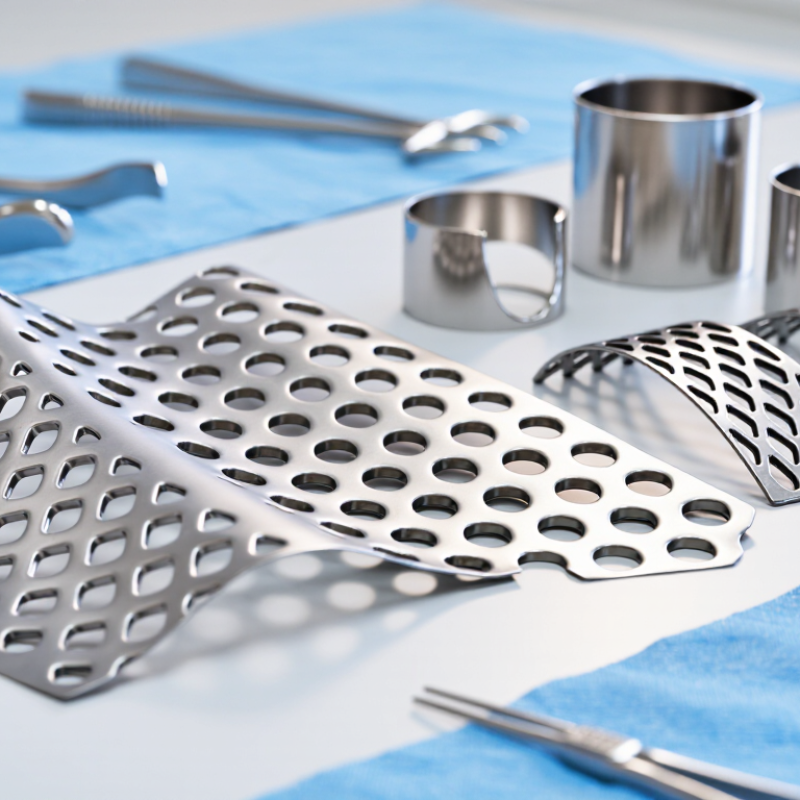
Titanium mesh for cranial repair is a thin, perforated sheet used to help rebuild or cover a skull defect. A defect may result from injury or a surgical procedure. The mesh is shaped to follow the patient’s skull contour, then secured to nearby bone with small fixation screws. It provides a supportive framework; it does not replace brain tissue.
The openings reduce the amount of solid material while allowing clinicians to secure the mesh at multiple points. In some repairs, surrounding tissue can grow near or through the openings over time, though healing varies. The goal is practical: restore a protective contour and support the reconstruction. Planning typically considers medical imaging, defect size, location, and the condition of the surrounding bone. Small differences in shape matter. A mesh that looks suitable on a scan may still need careful adjustment during surgery. No design fits every case, and titanium mesh cannot guarantee a particular cosmetic or medical outcome. The treating surgical team can explain why a specific repair approach is appropriate.
Cranial repair mesh is commonly manufactured from commercially pure titanium or titanium alloys. These materials combine strength with corrosion resistance and are used in implantable medical devices. Material grade, thickness, and manufacturing quality all matter. A thin sheet may be easier to shape, but it must still provide adequate support for the intended repair. Small details matter.
Design affects how mesh fits the skull. Openings allow fixation with screws and let clinicians trim or contour the sheet around a defect. Hole size and spacing influence flexibility, while rounded edges can reduce snagging during handling. Pre-contoured designs may suit some anatomies, though patient-specific shaping can still be necessary. No pattern fits every case. That is worth remembering.
Reliable product evaluation should consider documented material specifications, dimensional consistency, surface finish, and validated quality controls. Imaging compatibility also deserves attention; titanium can affect image quality near the implant, depending on the imaging method and implant geometry. A catalogue description alone cannot show how a mesh will behave in a particular repair. Surgeons assess the defect, surrounding anatomy, and fixation needs when choosing a design. Even a well-made mesh may require careful adjustment.
Cranial titanium mesh production begins with certified implant-grade sheet, commonly commercially pure titanium or Ti-6Al-4V ELI. ASTM F136 specifies 5.5–6.5% aluminum and 3.5–4.5% vanadium for the alloy. These limits help control material consistency; they do not, by themselves, prove that a finished mesh is safe or suitable. Manufacturers typically laser-cut or machine the pattern, then form it to match cranial contours. Edges are deburred, cleaned, and inspected for burrs, cracks, hole spacing, and dimensional accuracy. Small defects matter.
Testing combines material records, process checks, and finished-part inspection. Tensile results from representative material samples can verify strength against the applicable specification. Optical measurement or coordinate equipment checks mesh dimensions, while cleaning validation assesses residues and particles. ISO 13485 supports documented quality controls, and ISO 14971 provides a framework for managing device risks. Still, a perfect scan cannot reveal every process weakness. That deserves attention.
Tips: Ask for material certificates, inspection records, and clear acceptance criteria. A smooth edge is reassuring, but it is not a complete test.
Choosing a titanium mesh manufacturer for cranial repair means looking beyond a polished catalogue. Ask how material batches are traced and how thickness, pore size, and surface finish are checked. Request inspection records and clear specifications for each product. A useful quality review should include manufacturing controls, packaging details, and evidence that stated requirements are verified. Do not treat a certificate as proof of every product’s performance.
Compliance depends on the intended market and product configuration. Compare whether suppliers provide relevant quality-system documentation, material information, and support for regulatory submissions. Product range matters, too: available mesh shapes, thicknesses, fixation options, and custom contours can affect planning. Confirm which options are standard and which require a separate development or review process. Even a detailed scorecard can miss how a mesh handles during shaping. The comparison is not perfectly tidy.
Tips: Ask for sample specifications, not just brochures. Check lot traceability and change-control practices. Clarify sterile or non-sterile supply, where applicable. Keep questions specific. A supplier’s response time and willingness to explain limitations can also reveal how practical the working relationship may be.
Choosing a titanium mesh manufacturer involves more than comparing prices or catalog dimensions. Ask how the manufacturer controls material composition, thickness, pore size, and edge finish. Small variations matter. A mesh should be consistent across production lots and suited to the intended shaping and fixation process. Review material certificates, inspection records, and lot traceability. Clear documentation makes quality easier to assess.
Manufacturing experience is important, but specific evidence matters more than broad claims. Ask about dimensional inspection methods, surface finishing, packaging, and compatibility with the planned sterilization process. If designs are customized, discuss how changes are reviewed and verified before production. A manufacturer should answer technical questions plainly and provide relevant records. Vague replies are worth questioning. No checklist replaces careful clinical and technical review.
Tips: Request sample inspection data and a typical lot record. Compare mesh dimensions against your requirements, and clarify who handles design changes. One detail is easy to miss: edge quality.
It covers or supports a skull defect after injury or surgery. It is shaped to the skull and fixed to nearby bone with small screws. It does not replace brain tissue.
They reduce solid material and allow fixation at several points. Nearby tissue may grow near or through them over time. Healing varies.
Medical imaging, defect size, location, and surrounding bone condition guide planning. Small contour differences can matter. A scan is not the whole story.
No. It supports protective contour and reconstruction, but cannot guarantee medical or cosmetic outcomes. The surgical team can explain why an approach suits a case. Some uncertainty remains.
Implant-grade titanium sheet is cut or machined, then shaped to cranial contours. Edges are deburred and cleaned. Dimensions, holes, cracks, and burrs are inspected. Tiny flaws matter.
Checks may include material records, strength tests on representative samples, dimensional measurements, and cleaning validation. These support quality assessment. They cannot reveal every process weakness.
Ask for material certificates, inspection records, lot traceability, and clear acceptance criteria. Sample inspection data can help. Paperwork is not the entire review.
Review thickness, pore size, edge finish, dimensional consistency, packaging, and sterilization compatibility. Clarify how custom changes are verified. Edge quality is easy to overlook. Vague answers deserve follow-up.
This article explains how Titanium Mesh For Cranial Repair supports the reconstruction and protection of cranial defects. It outlines the mesh’s role in providing a stable framework while allowing surgeons to shape and position it to suit individual anatomical needs. Key material and design considerations include biocompatibility, strength, corrosion resistance, pore structure, thickness, and ease of contouring, all of which can influence performance and handling.
The article also reviews how manufacturers produce and test cranial titanium mesh, including checks for dimensional accuracy, material quality, surface condition, and consistent manufacturing. It compares manufacturers through their quality systems, regulatory compliance, technical documentation, and breadth of product options. Finally, it highlights practical selection factors such as clinical requirements, available mesh designs, customization support, product traceability, and the manufacturer’s ability to provide dependable technical information.
